Entering the Orthodox Church · Lesson 9 of 20
What Was the Property the Prodigal Wasted?
The parable of the Prodigal Son has one more depth to sound: its ascetic meaning — what it teaches about the inner life of the soul. Saint Gregory Palamas gives the key: the property the younger son received and squandered is the nous. “Above all our property and possessions,” he says, “is our own innate nous” — the spiritual eye of the heart, man’s finest attention, the center of his personality.
The soul, made in the image of the Trinity, has nous, reason, and spirit. In its natural condition the nous is illumined: it remembers God, dwells in Him, and directs all the soul’s powers rightly. A “prodigal” person, in the deepest sense, is one whose nous is squandered — dissipated on earthly things, sensual pleasures, and impassioned thoughts, with no remembrance of God. When the nous keeps God’s commandments, prudence functions and distinguishes good from evil; when the nous is scattered, the whole inner order collapses: the soul’s love, made to be aimed at God, falls to created things and becomes self-indulgence, love of money, ambition; and its anger, made to be aimed at the devil, turns against other people.
How Does Sin Actually Take Hold?
The tradition describes the anatomy of temptation with clinical precision. A suggestion enters through an impassioned thought, a sensory impression, or a fantasy — say, the glittering thought that to become rich one may steal. Its one aim is to capture the nous. If the nous is captured, the thought becomes a desire; the desire is acted on; the repeated act becomes a passion — and the man is enslaved, exactly as the prodigal was enslaved to the citizens of the far country. And the fathers name those citizens: the demons — fallen angels who out of envy will do anything to separate man from God. The greatest passion is pride, the first sin, which felled both demons and man.
The parable adds a devastating detail: the prodigal longed to fill his stomach with the pods the swine ate, “and no one gave him anything” [Luke 15:16]. Passion can never be satisfied. The more a man acquires, the more his hunger grows; there is one world and many greedy hearts, so the lover of possessions is hungry forever. Only God can fill the soul He made for Himself.
This corrects our shallow definition of sin. We usually think of sins as external acts — stealing, lying, anger. Those are sins, but they are fruit, not root. Sin is first the darkening and capture of the nous, the turning of the soul’s powers against nature, the departure from our real home. Saint Gregory Palamas goes so far as to say that without God’s grace within, whatever a man does is touched by sin — like the five foolish virgins, who practiced real self-control yet were shut out, because they had no oil, no grace, in their lamps [Matthew 25:1–13]. And this also reframes freedom: a man may be outwardly free in a free country and inwardly a slave; the martyrs in their chains were freer than many comfortable Christians today.
What, Then, Is Orthodox Asceticism?
Not a set of grim external exploits. Orthodox asceticism is the art of keeping the nous pure — purifying the heart and illumining the inner eye so that it holds constant remembrance of God. Prayer, fasting, vigil, and the keeping of the commandments are the exercises; the purified, watchful heart is the goal. When the nous has its right orientation, the whole human organism functions correctly — as when the conductor returns to the orchestra.
What Is True Repentance?
If sin is the darkening of the nous and departure from God, repentance is the illumination of the nous and the return. The parable shows its stages in five strokes.
First, “he came to himself” [Luke 15:17] — the scattered nous returns from the world of the senses into the heart, and the man wakes and sees his condition. Second, self-reproach: he blames no one else, counts himself unworthy to be called a son, and would be glad to be a servant. Third — and this the fathers stress — the awakening itself is not a human achievement but the visitation of grace: God lovingly reveals a few rays of His glory so that a man can see his darkness. Repentance is a divine inspiration. Fourth, resolution becomes action: he does not stop at good intentions — “he arose and came to his father” [Luke 15:20]. And fifth, the return ends not in a private absolution but at a feast: entrance into the house and participation in the thanksgiving dinner — the Eucharist. The forgiveness of sins is completed in communion with the Church.
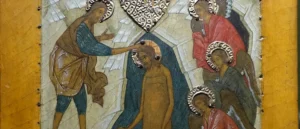
All of this illumines a word the Church uses for Baptism itself: illumination. In Baptism the nous is illumined, and with it desire, reason, and temper are sanctified — the whole man is set alight. The ascetic life, begun in the catechumenate and continued for a lifetime, is simply the keeping of that lamp burning.
This article is drawn from Entering the Orthodox Church by Metropolitan Hierotheos (Vlachos) of Nafpaktos, a guide to the catechism and baptism of adults, and is part of a series presenting its teaching.