Entering the Orthodox Church · Lesson 19 of 20
What Do We Await?
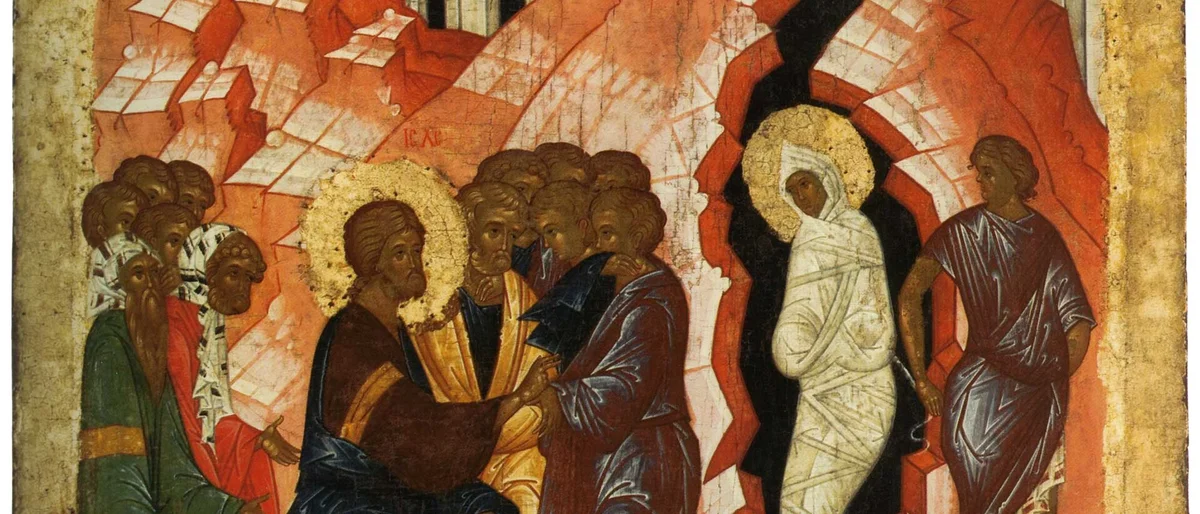
The Creed ends looking forward: “I look for the resurrection of the dead, and the life of the age to come. Amen.” The word is expectation — not a vague wish, but confident anticipation. At death the soul is separated from the body; at the resurrection God will raise the bodies, the souls will return to them, and the whole man will live. Everyone will rise — the righteous and the unrighteous alike [John 5:28–29] — for the resurrection is the restoration of human nature itself, God’s gift to all; how each person meets it depends on the life he brought to it.
What Is the Pledge of Our Resurrection?
Christ’s own. His Resurrection is the prelude to ours. And the Church possesses a remarkable ongoing witness: the relics of the saints. The saints already enjoy, in anticipation, the abolition of death — their departure is truly a “falling asleep,” and their incorrupt, sweet-fragranced, wonderworking relics are a foretaste of the coming resurrection. Metropolitan Hierotheos states the Church’s task with startling boldness: her work is to make man’s body a relic — a body so penetrated by grace that even death cannot make it merely a corpse.
The resurrection will certainly happen — we have Christ’s absolute assurance — but its hour is unknown; even the angels do not know it, only the Father [Matthew 24:36]. The raised bodies will be spiritual, as Saint Paul teaches: “sown in corruption… raised in incorruption; sown in dishonor… raised in glory; sown in weakness… raised in power; sown a natural body… raised a spiritual body” [1 Corinthians 15:42–44]. And those still alive at the Second Coming will not die at all, but will be changed “in a moment, in the twinkling of an eye” [1 Corinthians 15:51–52].
What Is the Life of the Age to Come?
Eternal life. Man’s life is not used up in this earthly existence, and the soul does not vanish when it leaves the body: the soul is immortal by grace — for everything created has, by nature, a beginning; but God has willed that the soul should never end. And since neither soul nor body alone is the whole man, but both together, the whole man will live eternally.
There are, however, two ways of experiencing eternity — the fathers called them “forever well” and “adversity forever.” The first is communion with God, participation in God as light; the second is estrangement from Him — the experience of the same God as darkness and fire. Everyone will see God; for the righteous the seeing will be participation and Paradise, while for those who refused Him there will be sight without participation, and that is hell. Eternity, in other words, is not God changing toward us, but us having become able — or unable — to receive Him.
Why Does the Creed End with “Amen”?
The final word carries two meanings at once: confirmation and prayer. Saying “Amen,” we affirm everything the Creed confesses as true — and we pray that all of it may be realized in our own personal life. It is both signature and supplication.
With that word the catechism of the Creed closes, and Metropolitan Hierotheos closes it as a father would: may this confession of faith become a living experience for us — may it enter into our personal life and become our blood and our nourishment. The Creed is not meant to be recited only; it is meant to be lived, until what we confess with the lips becomes what we see with the purified heart.
This article is drawn from Entering the Orthodox Church by Metropolitan Hierotheos (Vlachos) of Nafpaktos, a guide to the catechism and baptism of adults, and is part of a series presenting its teaching.