Entering the Orthodox Church · Lesson 10 of 20
What About the Elder Son?
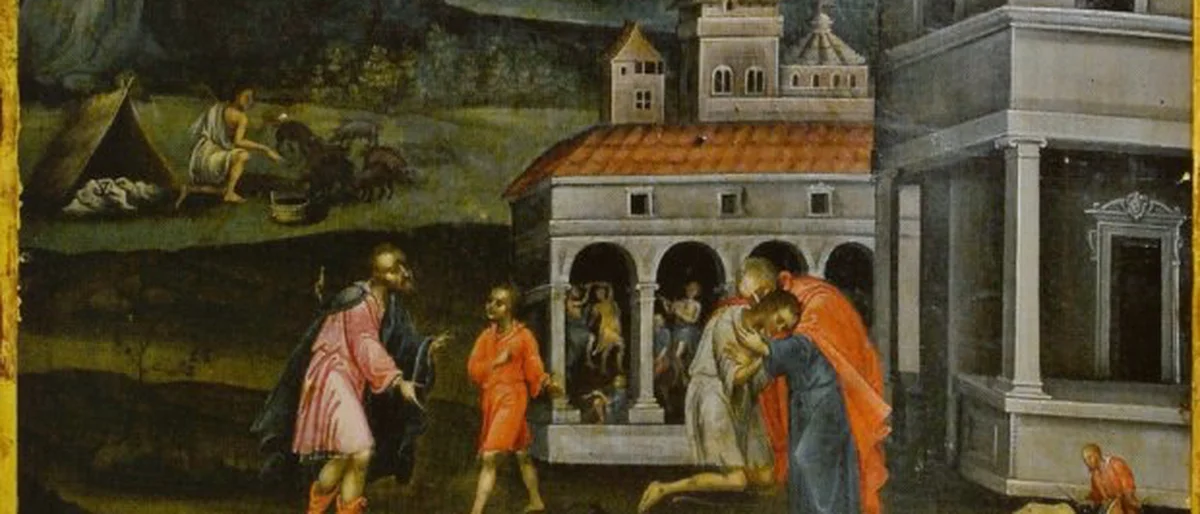
The parable has two sons. The younger left, fell, and returned. The elder stayed home, kept his formal duties — and in the end stood outside, scandalized by his father’s love for his returning brother. Told of the feast, “he was angry and would not go in” [Luke 15:28]; and his protest drips with resentment: not “my brother,” but “this son of yours… who has devoured your livelihood with harlots” [Luke 15:30].
The elder son is the portrait of those who remain in the Church only formally. He is a legalist: he believes he has kept every commandment, and from that keeping he derives demands and rights. But law-keeping without love does not make a true child of God. He has no compassion for his weary brother, no share in his father’s joy. While the younger son repents and enters the feast, the elder son reveals his own spiritual sickness — and stays outside the house. The parable’s quiet warning: it is possible to be near the Father’s house all one’s life and never enter His joy.
Can Members of the Church Be Sick?
Yes — and the Church has always said so honestly. Through Baptism and Chrismation we become members of the Body of Christ; but Baptism is the start of the new life, not its end. The Lord’s commission had two parts: “baptizing them… teaching them to observe all things that I have commanded you” [Matthew 28:19–20]. Baptism alone is not enough; the keeping of Christ’s commandments must follow, just as joining any body carries the obligations of membership. As Saint Symeon the New Theologian taught, a person must be baptized and sure in his faith — living the life his Baptism began.
What happens when a baptized Christian sins and grows cold? The grace of Baptism is never lost — it remains in the depth of the heart — but the passions cover it over. Such a person is a potential member of the Church rather than an active one: like a machine with full capacity for work but disconnected from its power supply, or a television with every capability of showing images, switched off. This is the sense in which Scripture and the fathers speak of sick and even dead members of the Church: biologically alive, sacramentally sealed, but without the active grace of God within.
What Does a Healthy Member Look Like?
Metropolitan Hierotheos sketches four marks of a true, living member of the Church.
First, he remains in the Church — not drifting into unbelief or heresy — accepting the faith of the Creed absolutely, participating in the sacraments, and practicing ascesis to keep God’s commandments. And he stays in the Church to be saved, not to save her: the Church, he notes dryly, does not need saviors.
Second, he knows he is a son, not an orphan. His great Father is God; and the clergy too are fathers to him — he is obedient to his bishop, has a spiritual father who guides him, and receives the teaching of the holy fathers, trying to imitate their life.
Third, he knows he belongs to a family, with spiritual brothers and sisters. He loves them; he does not judge or condemn them whatever their mistakes; he is tolerant of their weaknesses; their joy is his joy and their pain his pain — as the first Christians held everything in common [Acts 2:41–47]. Here is the elder son’s lesson in reverse: whoever keeps God’s law but has no love is not a real Christian, but a sick member.
Fourth, when he sins — and everyone sins: “If we say that we have no sin, we deceive ourselves” [1 John 1:8] — he follows a course of treatment. For sins are not merely guilty acts or broken rules; they are first of all wounds. The sinner is spiritually sick, and the Church meets him as a hospital meets a patient. The priest is a physician acting in the name of the Great Physician, Christ: he cleans and binds the wounds, and prescribes the remedy. Repentance, confession, and the spiritual father’s guidance — including penance — belong to this healing framework, not to a courtroom.
What Hope Does This Give?
Everything in this lesson is finally good news. The Church does not divide humanity into the perfect and the excluded; she is a hospital full of patients in every stage of recovery, presided over by a Physician who has never lost a case He was allowed to treat. The ancient Church even placed grave sinners back among the catechumens for a season — not to shame them, but to heal them, until they felt God’s grace working in their hearts again. The question the parable leaves with each of us is only this: will we come in to the feast — or stand outside with our rights? The Father, as always, comes out to plead with both sons.
This article is drawn from Entering the Orthodox Church by Metropolitan Hierotheos (Vlachos) of Nafpaktos, a guide to the catechism and baptism of adults, and is part of a series presenting its teaching.