Entering the Orthodox Church · Lesson 5 of 20
Why Do We Call God “Father”?
The parable of the Prodigal Son begins: “A certain man had two sons.” The central figure of the story is not the wandering son but the father — so much so that some interpreters prefer to call it the parable of the compassionate father. He receives his younger son’s insult with patience, watches for his return, runs to embrace him — and treats the elder son’s resentment with the same charity.
The image of the father carries a double meaning. It points first to the first Person of the Holy Trinity, from whom the Son is begotten before all ages and from whom the Holy Spirit proceeds; and second to God’s relationship with man, whom He created and loves. The catechumen’s first lesson about God is therefore this: the God of the Christians is not a force but a Father.
What Do We Mean by the Holy Trinity?
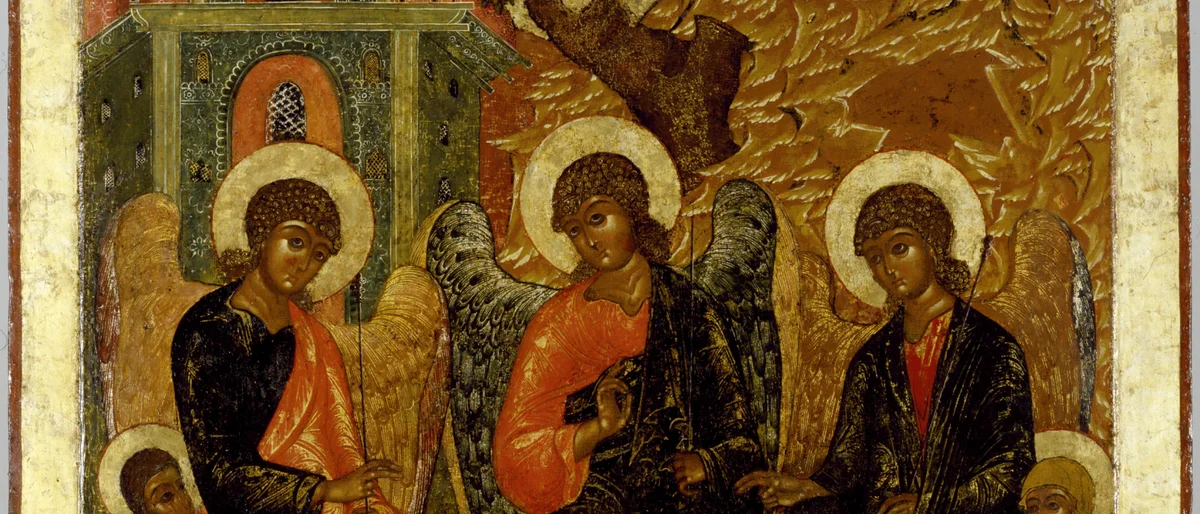
The true God whom the Orthodox worship is Trinity: Father, Son, and Holy Spirit — three Persons, one Essence, equal in honor, glory, and power. The Father is not superior to the Son, nor the Son to the Spirit; they are as equal, Metropolitan Hierotheos says, as the three sides of an equilateral triangle. The only distinction is of origin: the Son is eternally begotten of the Father, and the Spirit eternally proceeds from Him.
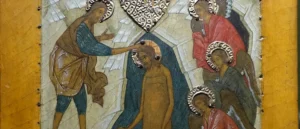
This truth is not a philosophical theory; it was revealed by Christ Himself. Saint Gregory Palamas went so far as to say that the very aim of the Incarnation was to reveal the Trinity, which mankind had not known. We see the Trinity at the Jordan: the Son is baptized, the Father’s voice declares Him beloved, the Spirit descends like a dove [Luke 3:22]. We see it again on Mount Tabor at the Transfiguration: the Son shining like the sun, the Father’s voice, the bright cloud of the Spirit. Christ spoke constantly of His Father — “I and My Father are one” — and before His Passion revealed the Spirit: “the Spirit of truth who proceeds from the Father, He will testify of Me” [John 15:26]. And after His Resurrection He sent the Apostles to baptize all nations “in the name of the Father and of the Son and of the Holy Spirit” [Matthew 28:19] — which is why every Orthodox baptism, and every Orthodox service, is sealed in the name of the Trinity.
How Can We Come to Know This Is True?
Metropolitan Hierotheos describes a movement: first by trust, then by experience. We accept the testimony of eyewitnesses in every other field — we believe astronauts about the moon and historians about the past, and we accept the discoveries of scientists we cannot personally verify, at least until we can repeat the experiment ourselves. The saints are the eyewitnesses of God: many of whom sealed their testimony with their blood. We begin by accepting their witness rationally; then, by following the way of life they followed, we come to our own personal confirmation. The best proof of the Holy Trinity, he writes, is the purification of the heart from the passions — for God’s grace enters the purified heart, and the person gains knowledge of God and becomes himself a dwelling place of the Trinity.
No created example can capture the uncreated God, but the fathers offered images: one sun — disk, ray, and radiance — one brightness, yet three distinguishable realities. The image limps, as all images do; the reality is known by grace.
Why Does It Matter That God Is Trinity?
Because only a Triune God can be love. Here lies the deepest difference between Christianity and every other conception of God. If God were a solitary unit, whom would He have loved before creation? Love requires another. A God without an eternal beloved either did not know love until He created — which would mean He changed, acquiring something He lacked — or love does not belong to His very being at all. But Scripture testifies that in God there is “no variation or shadow of turning” [James 1:17], and that “God is love” [1 John 4:8]. Because the Father eternally loves the Son in the Holy Spirit, love is not something God does; it is what God is.
The alternatives show what is at stake. In some Eastern religions, salvation is the dissolution of the person into the impersonal absolute, like a drop in the ocean — but such identification is not love, for love requires communion, relationship, and freedom preserved. In Islam, which denies that God has a Son, the emphasis falls on mercy and justice rather than love. The old pagan trinities — deities bound by rivalry, destruction, and passion — could save no one. Only the revelation of the Trinity gives us a God who is Personal, whose inner life is love, and who therefore can love us — not as an abstract higher power ruling the world, but as a Father who runs down the road to meet a returning child.
How Close Does This God Come?
Closer than we dare imagine. Christ calls those who do His Father’s will “My brother and sister and mother” [Matthew 12:50]; after His Resurrection He says, “Go and tell My brethren” [Matthew 28:10]; and at the Last Supper: “No longer do I call you servants… I have called you friends” [John 15:15]. Saint John Chrysostom put on Christ’s lips the most tender summary in patristic literature: I am Father, I am brother, I am bridegroom, I am dwelling place, I am food, I am raiment, I am root, I am foundation — I am whatever you want Me to be; only stay close to Me.
The teaching about God in Trinity, Metropolitan Hierotheos concludes, is the alpha and the omega of our faith — and he notes the lovely providence that in Greek the word for love, agapō, begins with alpha and ends with omega. The Triune God is love, and loves man beyond measure — even to the sacrifice of the Cross.
This article is drawn from Entering the Orthodox Church by Metropolitan Hierotheos (Vlachos) of Nafpaktos, a guide to the catechism and baptism of adults, and is part of a series presenting its teaching.