Entering the Orthodox Church · Lesson 14 of 20
Why Did God Become Man?
Man is God’s most perfect creation — and through the Fall he was enslaved to the devil, sin, and death. God could not bear to see His creature tormented. Out of love He sent His Son to become man and save man. The fathers call this whole work the Divine Economy: God’s loving “accommodation” of Himself to our condition in order to rescue us.
“Who for us men”: the Word did not need to become man for His own sake. He became man solely for us — the measure of a love that takes on human nature in order to unite it with the divine. “And for our salvation”: and salvation here does not mean what the ancient philosophers and some Eastern religions imagine — the soul’s escape from the body. It means man’s deliverance from sin, death, and the devil, and his union with God — the salvation of the whole person.
“Came down from heaven”: the Word did not cease to be God, nor abandon the throne of heaven. As the Akathist Hymn sings, “this was a divine condescension, not a change of place.” The Son bent down to us without leaving the Father.
What Do We Confess About the Virgin Mary?
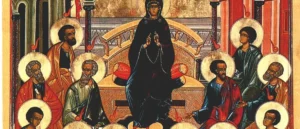
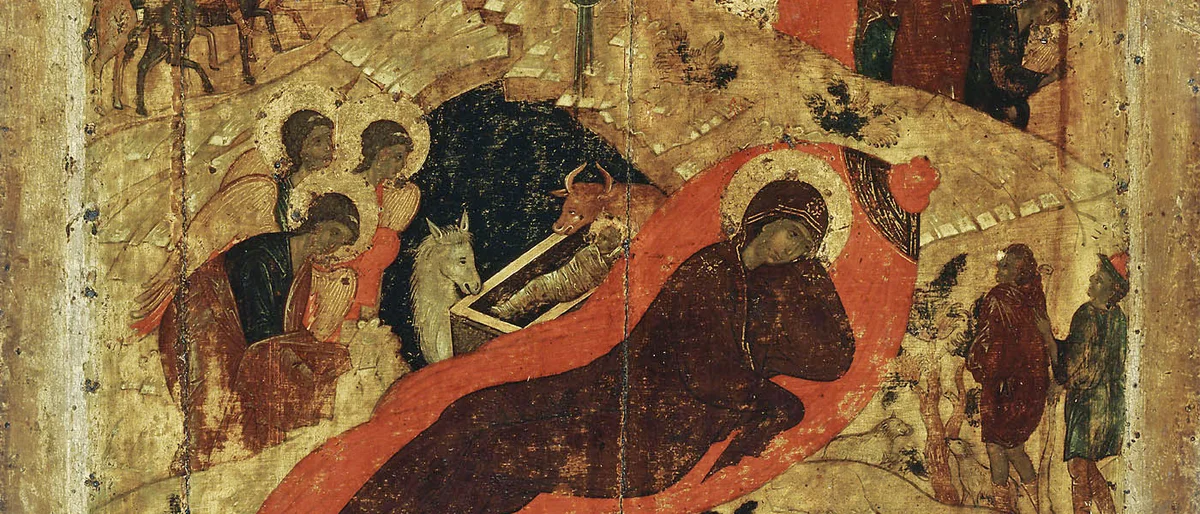
Christ’s conception was not as ours: it took place of the Holy Spirit in the womb of the Virgin Mary, without man — as the Annunciation reveals [Luke 1:26–38]. This is why the Church calls her Theotokos, Birthgiver of God: she gave birth not to a mere man but to God incarnate — the very point defended by the Third Ecumenical Council. She is Ever-Virgin: virgin before, during, and after the birth — which is why her icons bear three stars, on her head and on each shoulder.
Her purity, Metropolitan Hierotheos explains, came from three streams at once: the grace of God, her own personal ascetic struggle, and the long, successive purification of her ancestors — all the purifications of the Old Testament had her in view. Her parents, Joachim and Anna, conceived her with prayer, fasting, and obedience. She is the flower of Israel’s whole history, prepared to give her flesh to God.
What Does “And Became Man” Mean?
That Christ is perfect God and perfect man. He took on the whole of human nature — body, soul, nous, everything human — and deified it. The fathers loved to repeat: what is not assumed is not healed; He assumed all of us, so all of us can be saved.
Because He is perfect God and perfect man, Christ has two natures, two wills, two energies, united — in the Church’s four famous adverbs — without confusion, without change, without division, without separation. Each nature keeps its own properties, yet they act in perfect communion. At the tomb of Lazarus, His human nature wept — and His divine nature raised the dead man; both, in the one Christ. The classic image is iron in the fire: the glowing iron is wholly fire and wholly iron, each nature keeping its own character — though even this image limps, the fathers admit, since in Christ one nature is uncreated and the other created.
Did Christ Share Our Weaknesses?
The human nature Christ took from the Virgin was pure and sinless — He never committed sin. Yet He freely took on what the fathers call the “blameless passions”: hunger, thirst, fatigue, even mortality — the weaknesses of our condition that involve no sin. And He bore them as Master, not as victim: His divinity governed them, permitting them for our sake. If Moses on Sinai could remain forty days without food while held in the vision of God, how much more did the incarnate Word rule the needs of the true body He took for us.
The mystery of the Incarnation exceeds every mind. The saints who attain the vision of God and know the transfiguration of their own nature by God’s uncreated grace understand it best — and even they see only in part. We accept it, Metropolitan Hierotheos says simply, and proceed to sanctification: for the purpose of the Incarnation is not to give us a puzzle, but to give us life.
This article is drawn from Entering the Orthodox Church by Metropolitan Hierotheos (Vlachos) of Nafpaktos, a guide to the catechism and baptism of adults, and is part of a series presenting its teaching.