Entering the Orthodox Church · Lesson 15 of 20
Why Was Christ Crucified?
“He was crucified for us under Pontius Pilate.” Christ really died on the Cross — the most painful and terrible of deaths — and the reality of that death proves the reality of His body. The mention of Pontius Pilate anchors the event in history: this happened, at a datable time, under a named governor.
Metropolitan Hierotheos emphasizes that Christ freely endures the Cross out of love, overcoming sin and death and giving us life. God is not driven by wounded pride or human anger. Scripture and the Church also speak of sacrifice, reconciliation, and judgment; these expressions must be understood within the one saving love of the Father, the Son, and the Holy Spirit.
“And suffered”: His human nature suffered — not His divine nature, which cannot suffer, though it remained united to the suffering humanity and underwent the Passion together with it. Two images help: the sun’s rays fall on a tree, but the axe that cuts the tree cannot cut the sunlight; water quenches the fire in glowing iron, but does not destroy the iron. So the impassible divinity remained undivided from the humanity that suffered.
What Happened Between the Burial and the Resurrection?
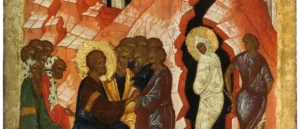
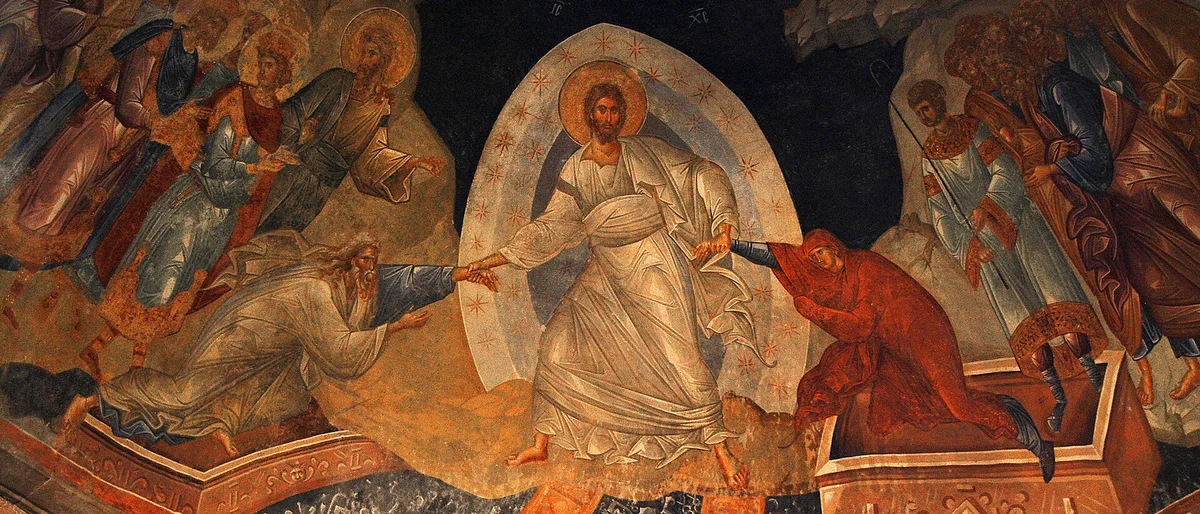
Christ was buried in a new tomb by Joseph of Arimathea and Nicodemus. And here the Church confesses a wonder: in death, His divinity was separated neither from His body nor from His soul. The body lay in the grave united to His divinity — and therefore remained incorrupt; the soul, united to His divinity, descended into Hades, where the souls of the dead were held — and set free the righteous of the Old Testament. This is the “Harrowing of Hades” shown in the Orthodox icon of Pascha: Christ trampling the broken gates, grasping Adam and Eve by the wrists and pulling them from their tombs. Even the incorrupt relics of the saints, which the Church venerates, are a distant echo of that incorrupt body in the tomb.
What Do We Confess About the Resurrection?
On the third day the soul returned to the body: Christ’s divinity raised His human nature. He appeared to the Myrrh-bearing Women and the disciples, giving them peace, joy, His blessing, and the Holy Spirit for the forgiveness of sins. His risen body was incorruptible and spiritual, bound by no distance or door — and this is the very body our own resurrection bodies will resemble, for Christ’s Resurrection is the prelude to ours.
“According to the Scriptures”: the astonishing fact is that all of this was described in advance. The prophets — above all Isaiah, the “fifth Evangelist,” eight hundred years before — set down the details of the Passion and its issue. Nothing took God by surprise; the whole economy was announced.
What Do the Ascension and the Second Coming Mean?
“He ascended into heaven and sits at the right hand of the Father”: as the “descent” meant not a change of place but the assumption of human nature, so the Ascension means that Christ raised up and glorified that human nature. Our flesh is now enthroned — and precisely because Christ deified human nature and seated it at the Father’s right hand, our own salvation is possible.
“And He shall come again with glory”: His first coming, in Bethlehem, was poor and hidden; His second will be in unmistakable glory, with His angels, on the throne of judgment. Its time is wholly unknown — even to the angels [Matthew 24:36].
What Are Paradise and Hell?
At the Judgment, the living and the resurrected dead will stand before Christ [Matthew 25:31–46]. And here Metropolitan Hierotheos hands on one of the most illuminating teachings of the Orthodox tradition: everyone will see God — but for some, that vision will be Paradise, and for others, hell. Those who have acquired a pure spiritual eye in this life will see God’s glory as light; the spiritually blind will experience the same glory as fire. The sun gives one energy that illumines the seeing and warms — or burns — the blind. Heaven and hell are not two locations but two ways of experiencing the one unquenchable love of God; this is exactly how the iconography of the Second Coming paints it, with the righteous in bright clouds and the river of fire flowing from the same throne.
“Whose Kingdom shall have no end”: the Kingdom is man’s communion with God — tasted now as a betrothal, to be celebrated then as the marriage feast, eternal and without end. The Creed’s confession of Christ closes, like the Gospel itself, not with a threat but with an invitation: to purify the eye of the heart now, so that His appearing will be our joy.
This article is drawn from Entering the Orthodox Church by Metropolitan Hierotheos (Vlachos) of Nafpaktos, a guide to the catechism and baptism of adults, and is part of a series presenting its teaching.