Entering the Orthodox Church · Lesson 13 of 20
What Do the Three Names Confess?
The Creed’s second article opens with three names, and each carries doctrine. “Lord” means ruler and master: Christ is Lord of the world as His Father is — for the Father created the world through the Son with the cooperation of the Holy Spirit, and all Three Persons uphold and govern it, equal in honor and power. “Jesus” means Savior [Matthew 1:21], and points to the human nature He assumed and deified. “Christ,” the Anointed One, the Messiah, denotes the union of divine and human nature in the one Person of the Word. Three names, one confession: true God, become true man, to save us.
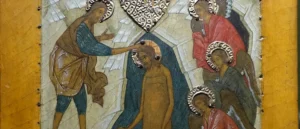
“The Son of God”: this the Father Himself revealed — at the Jordan and again on Tabor, His voice was heard: “This is My beloved Son. Listen to Him” [Mark 9:7].
“The Only-begotten”: the Father has no other Son by nature. We too can become sons of God — but by grace. Metropolitan Hierotheos offers the image of a father who begets one child and adopts another: both live in the same house and share the same table, but the first is son by nature, the second by adoption. So it stands between Christ and us — with this joy, that the adoption is real.
What Does “Begotten of the Father Before All Ages” Mean?
Human reason cannot grasp what the begetting of the Son is, any more than the procession of the Spirit; these were revealed to us in human images. What the word “begotten” secures is the divinity of the Word — that He is of the same essence as the Father. “Begotten” and “proceeding” name the particular way each Person has His existence: one essence, distinct personal attributes. The saints who have been granted the vision of God know this relationship not by syllogism but by experience; the rest of us accept their revelation first, as we accept any true witness, on the way to our own.
What Does “Light of Light” Mean?
When the saints attain the experience of revelation, what they see is that God is light. The Church chants: God is Light; the Word is Light; the Holy Spirit is Light. This shone openly at the Transfiguration: the face of Christ blazed from His divinity, the Spirit was present in the bright cloud, and the Father spoke from the light [Matthew 17:1–8]. It is worth noticing, Metropolitan Hierotheos observes, that the liturgical texts hymn God as light even more often than as love.
And this light is uncreated — the light of divinity, not the created light of the sun. We are made worthy to partake of God’s energies, never of His essence: as the sun remains far beyond us while we live in its warmth and light, so God remains incomprehensible in essence while truly giving Himself to us in His grace. The Persons of the Trinity share the divine essence; we are given the divine energies — and that gift is enough to deify us.
Why “True God of True God” and “Begotten, Not Made”?
“True God” stands against every false god. Many things have presented themselves as gods and still do — fabrications of human imagination. The true God is known within the Church, because Christ revealed Him; and for this reason we entrust our salvation to Christ alone.
“Begotten, not made” answers the Arian heresy, which claimed Christ is a creature made by God — a teaching that shakes the very foundations of the faith. The difference is absolute, and a workshop illustrates it: a blacksmith begets children and produces ironwork. His children share his nature; his products do not. The Son is begotten, not produced — “of one essence with the Father,” as the next phrase drives home with the famous word of Nicaea. What the Father is, the Son is.
What Does “Through Whom All Things Were Made” Answer?
Two errors at once. Against the Arians, it confesses that the Son is the Creator — and the Creator cannot be a creature. And against the Gnostics, who taught that some lower god made this world and blamed the world’s evil on him, it confesses that the one good God made all things: the Father, through the Son, with the cooperation of the Holy Spirit — and made them very good. Evil is no part of the fabric; it is a parasite that entered through the fall. The world’s Maker is the world’s Lover — and, in the article that follows, the world’s Redeemer: for this same Son, through whom all things were made, “for us men and for our salvation came down from heaven.”
This article is drawn from Entering the Orthodox Church by Metropolitan Hierotheos (Vlachos) of Nafpaktos, a guide to the catechism and baptism of adults, and is part of a series presenting its teaching.