Entering the Orthodox Church · Lesson 11 of 20
Where Did Creeds Come From?
After walking through the Parable of the Prodigal Son, the catechumen turns to the Symbol of Faith — the Creed — which he will declare with his own mouth before his Baptism and then recite continually as a member of the Church. But why does the Church have creeds at all?
From the very beginning, Metropolitan Hierotheos explains, the Church found brief confessional statements necessary for two reasons: to define the limits between truth and error — expressing the Orthodox faith in a few words so heresies could be confronted — and to serve as baptismal confessions, so that catechumens could confess the faith before entering the font. The earliest creeds confessed simply that Christ is the Son of God; then came two-part creeds confessing the Father and the Son; then three-part creeds confessing Father, Son, and Holy Spirit.
The seed of them all is the Lord’s own baptismal command: “Go therefore and make disciples of all nations, baptizing them in the name of the Father and of the Son and of the Holy Spirit” [Matthew 28:19]. From that first and briefest formula, every later confession grew.
Are There Creeds Inside the New Testament?
Almost certainly. The apostolic Church already spoke of guarding the “deposit” and the “confession,” and Hebrews lists “the instruction of baptisms” among the foundations [Hebrews 6:1–2]. Scholars point to passages whose rhythm suggests they were confessed aloud before Baptism. One is the “mystery of godliness” in 1 Timothy 3:16: “God was manifested in the flesh, justified in the Spirit, seen by angels, preached among the Gentiles, believed on in the world, received up in glory.” Another is Saint Paul’s summary of the Gospel he himself “received”: that Christ died for our sins according to the Scriptures, was buried, and rose again the third day [1 Corinthians 15:3–8]. A third is the great hymn of Philippians 2:5–11 — Christ who, being in the form of God, emptied Himself, humbled Himself to the death of the cross, and was exalted with the name above every name.
All of these confess the same core: Christ is truly God, who became man for man’s salvation. When the fathers later wrote creeds against the heretics — Saint Ignatius, Saint Irenaeus, Saint Justin Martyr all left such texts — they were extending a practice as old as the Apostles.
Where Does Our Creed Come From?
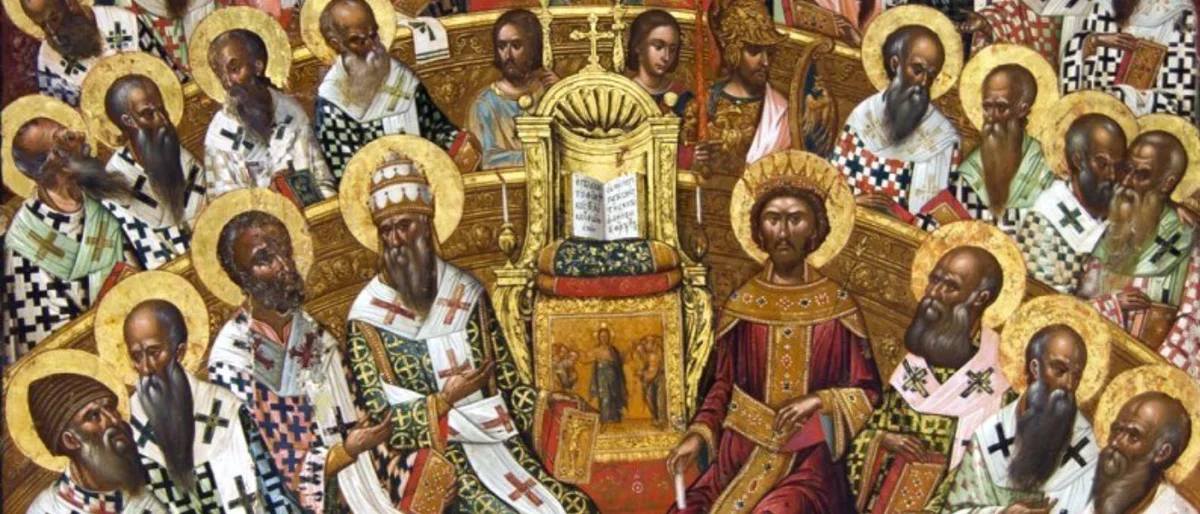
The Symbol of Faith used today — for the catechumen’s confession before Baptism and the faithful’s confession at every Liturgy — is the work of the First and Second Ecumenical Councils: its first articles composed at Nicaea in 325, and its completion at Constantinople in 381. The rise of heresies that distorted the revealed faith with philosophy and speculation — above all Arianism — made this summary of Orthodox teaching necessary. The catechist’s aim, Metropolitan Hierotheos notes, is for the catechumen to learn it by heart: twelve short articles, from “I believe in one God” to “the life of the age to come. Amen.”
A small detail carries a lovely meaning: the conciliar fathers wrote “we believe,” confessing as a body; the Church also recites it as “I believe,” because the faith must become each person’s own. The Creed is both the Church’s common confession and every believer’s personal one.
What Are the Creed’s Five Central Points?
Metropolitan Hierotheos gathers the whole Creed into five affirmations. First: the Father, who created the whole world through the Son. Second: the divinity of the Word, the Second Person of the Holy Trinity, and His becoming man for our salvation — a confession that contains the entire divine economy: the Nativity, the Crucifixion, the Resurrection, the Ascension, and the Second Coming. Third: the divinity of the Holy Spirit, the Third Person — so that God is One in three Persons, as we sing in the Liturgy: “the Trinity, one in essence and undivided.” Fourth: the Church and her sacramental life, which begins with Holy Baptism. Fifth: the resurrection of the dead and the life of the age to come.
The whole faith of the Church stands within these five points — and they are not optional. If we do not believe in the Trinity; if we do not believe that God took on human nature to save man; if we do not believe in the uniqueness of the Church; if we do not believe in the resurrection of the dead — we shake the foundations of the entire faith. To reject any one of them, Metropolitan Hierotheos says plainly, is to show in practice that we are not real Christians.
In the lessons that follow, the Creed is opened phrase by phrase — beginning where it begins: with God the Creator.
This article is drawn from Entering the Orthodox Church by Metropolitan Hierotheos (Vlachos) of Nafpaktos, a guide to the catechism and baptism of adults, and is part of a series presenting its teaching.