Entering the Orthodox Church · Lesson 6 of 20
In What Sense Are We Children of God?
In the parable of the Prodigal Son, both sons live in their father’s house and enjoy his goods. God is called Father in relation to His only-begotten Son and in relation to us — but with a vast difference. The Father begot the Son before all ages; He created man within time. The Son is God’s child by nature; we are His children by grace. Metropolitan Hierotheos offers a homely image: an artist both paints pictures and begets children. The painting is his work, expressing his thought and gift; the child is of his own nature. Man is God’s painting — and is invited, by grace, to become His child.
How Was Man Created?
God first created the angels — the noetic, invisible realm — and then, through the days of creation, the whole sensible world: nature, birds, fish, animals, plants. On the sixth day He created man, who alone is both noetic and sensible, having soul and body together. The fathers put it beautifully: first God created the kingdom and the palaces, and then the king — for man was made to reign over the world.
Scripture says man was made “in the image and likeness” of God [Genesis 1:26]. The image refers to what man is: his nous — the spiritual eye of the heart, the center of his personality — his reason, and his freedom; a created reflection of God who is Nous, Logos, and Spirit. The likeness refers to what man is for: he was created to become by grace what God is by nature. The image is our ontology; the likeness is our destination. Man’s archetype is the Word of God Himself — as if Christ were the original and every human being a photograph printed from that film, meant to be kept clean and true to its original.
This gives every person a nobility nothing can erase. Man is of princely lineage; his aims cannot be exhausted by food, drink, work, and recreation — nor even by study and marriage, good as they are. Saint Gregory the Theologian defined man as a living creature “sustained here, but transferred elsewhere — and, the completion of the mystery, deified by its inclination toward God.” We are provided for in this life, but we are journeying to another; and the end of the journey is deification by grace.
What Was Paradise?
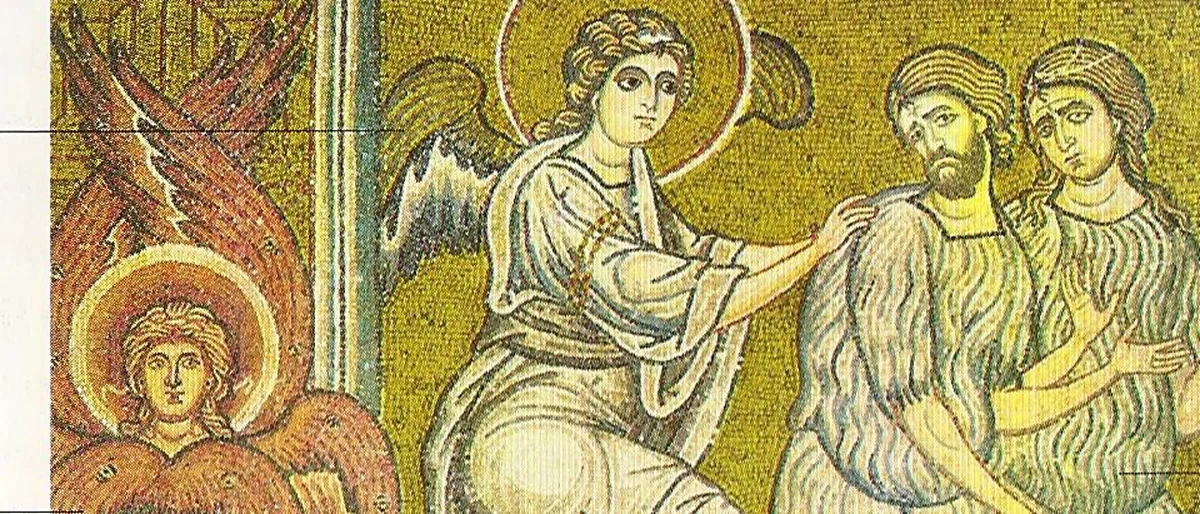
The two sons living in their father’s house image man’s first state: immediately after his creation, man lived in the house of God — in Paradise, in true communion with Him. Paradise was both a place and a relationship; Adam and Eve, clothed in divine grace, lived like the angels.
What Was the Fall?
“Father, give me the portion of goods that falls to me… and the younger son gathered all together, journeyed to a far country, and there wasted his possessions with prodigal living” [Luke 15:12–13]. Here the parable maps the Fall exactly. Saint Gregory Palamas noticed that the younger son images sin itself: virtue is first-born, and sin is younger — “a discovery born later,” the result of man’s bad choice. God created man pure, capable of deification; man used his freedom to detach himself from God — to take God’s gifts as private property and live by his own will instead of God’s, making himself and his desires the center of everything. That is the essence of the ancestral sin, and of every sin since.
The parable’s stages trace every fall: appropriation of the property, emigration to the far country, squandering of what is essential, deprivation, and finally subjugation — the prince feeding pigs for “a citizen of that country.” The fathers did not hesitate to name that citizen: far from the Father’s house, man becomes the servant of the devil. Made to live in the royal palace, he prefers rags, hunger, and the indulgence of the senses.
What Are the Consequences of the Fall?
Death — first spiritual, then bodily. The soul is the life of the body, but the life of the soul is the Holy Spirit; without the Spirit, man is spiritually dead even while he moves, works, and succeeds. The father in the parable says it plainly: “this my son was dead, and is alive again” [Luke 15:24]. Saint John of Damascus describes the sequence: through sin man was stripped of divine grace, his image was darkened, and death followed — sickness, mortality, and at last the separation of soul from body.
Saint Macarius the Egyptian gave two unforgettable images of the soul without the Spirit: meat without salt, which spoils and stinks; and a coin without the king’s image, counterfeit and worthless. And Saint Gregory of Nyssa said what modern restlessness confirms daily: the life of those apart from God “is not a life; it is merely labelled as one.” Christ Himself said, “I am the Way, the Truth, and the Life” [John 14:6] — apart from Him, man is locked in the prison of his senses and his mortality, deprived of love, of freedom, of home.
Why Does This Matter for Someone Seeking Baptism?
Because it names the real reason to seek it. The desire for Baptism, Metropolitan Hierotheos writes, must not be social or external. It belongs in this parable’s perspective: a person asks for Baptism in order to return from death to life, from the far country to the Father’s house, from deprivation to abundance, from being an orphan to having a Father. And the whole Gospel is in this: the way home is open, and the Father is already watching the road.
This article is drawn from Entering the Orthodox Church by Metropolitan Hierotheos (Vlachos) of Nafpaktos, a guide to the catechism and baptism of adults, and is part of a series presenting its teaching.