Adapted from the Greek of Andreas Theodorou, Απαντήσεις σε ερωτήματα συμβολικά (Answers to Questions in Comparative Theology), published by Apostoliki Diakonia of the Church of Greece. This English presentation has been edited for parish reading.
What Is the Christian Understanding of God?
The distinctive characteristic of the Christian understanding of God, which sets it apart from every non-Christian concept of God, is the union of oneness and Trinity.
That is, God is one in essence or nature and three in Persons or hypostases.
The unity of the divine essence protects the Christian understanding of God from every form of polytheism, such as that of ancient pagan religion, in which there was a multitude of gods.
The Father, the Son, and the Holy Spirit are distinct Persons, yet one God. This confession is central to Christian faith and worship.
How Should We Understand the Persons, or Hypostases, in God?
There are three hypostases in God:
the Father,
the Son,
and the Holy Spirit.
They are not merely names or empty titles without real content.
Nor are they simply manifestations or masks assumed by the one divine nature in order to communicate outwardly with the world—in creation, revelation, and salvation—as Sabellianism taught in the ancient Church.
Neither are they three independently existing centers into which the whole essence of God is divided and separately expressed.
Rather, they are modes of existence of the one God, in whom the Godhead is at the same time both distinguished and united.
Although the three hypostases are real distinctions in God, they do not break apart or divide the one divine nature into three separate gods, because each Person is a complete bearer of the divine essence, divine energy, and divine will.
The Persons also mutually indwell one another; that is, each is in the other two, and they are united with one another in love.
Thus, in the Holy Trinity there are both distinctions and unities.
The distinctions are the hypostases.
The unities are the one essence, the one will, and the one energy.
What Are the Divine Energies?
The divine energies are an essential element in the understanding of God.
They are eternal, divine distinctions within the Godhead.
God is understood together with His divine energies, because the energies too are uncreated and belong to the full and perfect God, just as do the divine hypostases and the divine nature.
The energies are the inherent richness of the Godhead.
They are not something external or something added to the essence of God.
Nor are they merely names without real content. The same is true of the divine hypostases.
The divine energies do not introduce composition into the absolute simplicity of the divine nature.
They are real distinctions, but they exist in a manner proper to God—that is, in a manner appropriate to the infinite divine nature and therefore beyond the grasp of our human understanding.
The divine energies have an extremely important role.
While the divine essence is absolutely transcendent, unknowable, imparticipable, and incommunicable, the divine energies are participable and communicable.
Through them takes place everything that God does outside Himself: the creation of the world, God’s outward manifestation and revelation, and the salvation of humanity.
The divine energies are many according to the different kinds of God’s outward activity.
Other names used for the divine energy are:
divine grace,
the uncreated light of Christ,
and the glory of the Holy Trinity.
Does Roman Theology Accept the Distinction of the Divine Energies?
Orthodox theology distinguishes between God’s essence, which is beyond our comprehension, and His uncreated energies, through which He makes Himself known and gives us communion with Him. This distinction does not divide God.
The Greek source contrasts this teaching with scholastic accounts of divine simplicity and grace in the Latin West. These traditions use different theological terms; a brief comparison cannot represent every Catholic theologian or resolve the wider discussion.
What Are the Relationships of the Three Persons of the Trinity to One Another?
The relationships of the Son and the Holy Spirit to the Father are relationships of origin.
Within the Holy Trinity, the Father is the source of divinity.
He is the principle of the Godhead.
From this point of view, the Father is without origin: He has no source or origin from another.
He is also without beginning in the temporal sense. He is eternal.
The other two Persons of the Trinity, in relation to the Father, are not without origin, because they have their origin from Him.
Nevertheless, they are co-beginningless and co-eternal with Him.
The Son receives His divinity from the Father through generation.
Likewise, the Holy Spirit receives His divinity from the Father through procession.
These origins from the Father are eternal.
They are not events or moments that take place in time within the Godhead.
The measurement of time cannot apply to the infinite nature of God.
The expression that conveys this truth is:
“Together the Father, together the Son, together the Holy Spirit.”
To introduce time into the relationships of the Trinity would destroy the infinity of the Godhead.
Arius, by teaching that the generation of the Son occurred in time, denied the divinity of the Word.
The eternal character of the relationships among the divine Persons, together with the truth that each Person is the complete and perfect bearer of the divine nature, excludes the idea that the Father—as the source of divinity and as the One who generates the Son and brings forth the Holy Spirit—is superior to the other two Persons, or that the Son and the Holy Spirit are subordinate to Him.
All three hypostases of God are consubstantial and equal in honor.
Categories of quantity—such as greater and lesser—have no place in the infinity of the Godhead.
What Are the Personal Properties of the Persons of the Trinity?
The personal, or hypostatic, properties of the Persons of the Holy Trinity are the following:
The Father
The property of the Father is that He is unbegotten and without origin.
The Father has no source from which He comes.
He is not begotten from anyone.
He exists from Himself and communicates His divinity to the other two Persons of the Holy Trinity.
The Son
The property of the Son is generation.
The Son is eternally begotten from the Father.
He is without beginning in the temporal sense of the term, although not without origin in the sense of His personal relationship, because He receives His divinity from the Father.
The Holy Spirit
The property of the Holy Spirit is procession.
Generation and procession are not the same thing.
They differ from one another, although we do not know the nature of that difference.
These hypostatic properties are strictly personal, incommunicable, and non-transferable.
In other words, the personal property of one Person cannot be transferred to either of the other Persons.
This principle constitutes the order of the Holy Trinity.
To abolish this order would overturn the very understanding of the Triune God, as will be seen later in the discussion concerning the procession of the Holy Spirit and the Filioque.
Is the Doctrine of the Holy Trinity Witnessed to in Holy Scripture?
In the Old Testament, the doctrine is indicated so faintly and mysteriously that, without the light shed upon it by the New Testament, it would be impossible to reconstruct from it the full doctrine concerning the Holy Trinity.
The doctrine can be glimpsed in passages in which God appears to speak and deliberate in the plural:
“Let Us make man in Our image…”⁹
“Behold, Adam has become like one of Us.”¹⁰
“Come, let Us go down and there confuse their language.”¹¹
Hints of the Trinity are also found in the variety of names attributed to God, such as Elohim, Adonai, Sabaoth, Jehovah, and others.
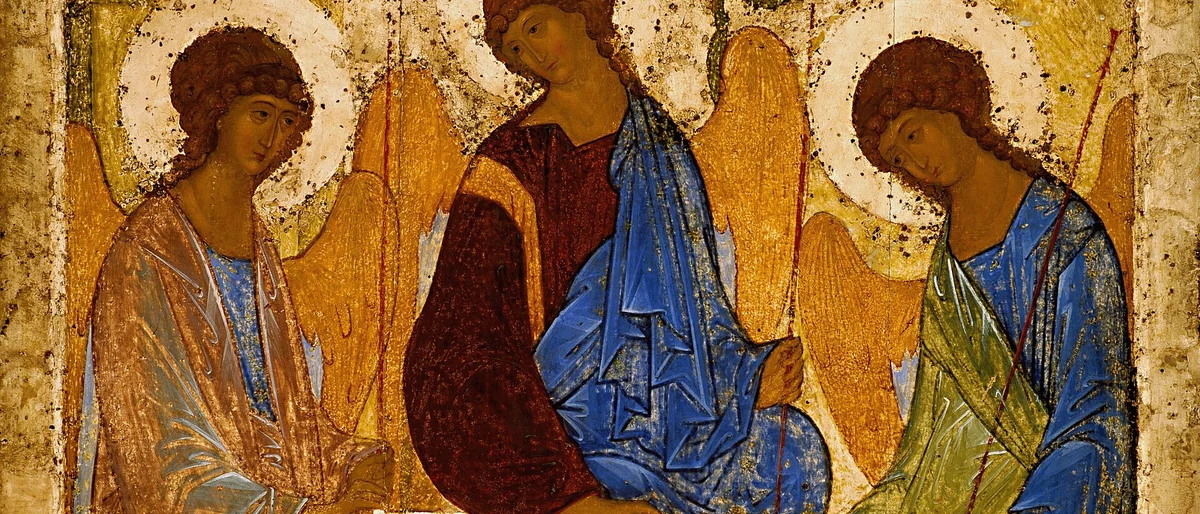
There is also the appearance of God to Abraham near the Oak of Mamre in the form of three persons, or angels.¹²
In the same spirit are those passages in the Old Testament that speak of the Spirit as the source of power and life in created beings,¹³ and of Wisdom as existing in God and working all things.¹⁴
In contrast to the Old Testament, where the doctrine of the Triune God is present only dimly, in the New Testament it is witnessed to much more richly, clearly, and explicitly.
The relevant passages can be considered in two groups:
first, passages in which the Trinitarian character of the Christian God is explicitly expressed;
and second, passages in which the relationships among the Persons within the Trinity are emphasized.
Among the first group are the following:
Matthew 28:19
“Go therefore and make disciples of all nations, baptizing them in the name of the Father and of the Son and of the Holy Spirit.”
Here both the unity and the Trinity of the divine Persons are emphasized at the same time.
2 Corinthians 13:13
“The grace of our Lord Jesus Christ and the love of God and the communion of the Holy Spirit be with you all.”
Here the Trinitarian character of God is clearly expressed.
1 Peter 1:2
“According to the foreknowledge of God the Father, in the sanctification of the Spirit, for obedience and sprinkling with the blood of Jesus Christ.”
The text also cites:
1 John 5:7
“There are three who bear witness in heaven: the Father, the Word, and the Holy Spirit, and these three are one.”
The author notes that this would indeed be a classic passage concerning the Triune God, but also states that it is regarded as a later interpolation into the biblical text.
In the second group there are many passages concerning the internal relationships of the divine Persons. Among the most important are:
John 1:1
“In the beginning was the Word, and the Word was with God, and the Word was God…”
Here the internal distinction and the union of the Word with the Father are expressly stated.
1 Corinthians 2:10
“For the Spirit searches all things, even the depths of God.”
Here the Spirit is presented as a distinct Person who searches the depths of the divine essence.
On the basis of these many clear references in the New Testament, the Church authoritatively confirmed the doctrine of the Holy Trinity in the sacred Creed formulated by the first two Ecumenical Councils:
Nicaea in 325 and
Constantinople in 381.
Is the Divinity of the Son and the Holy Spirit Witnessed to in Scripture?
Most certainly.
The relevant passages are clear and unmistakable.
The text says that Christians should know them well so that they may answer those who deny the divinity of the Word and of the Holy Spirit, mentioning especially the Jehovah’s Witnesses, whom the author identifies as followers of the teaching of Arius even though they appeared some sixteen centuries later.
Concerning the divinity of the Holy Spirit, a classic passage cited by the author is Acts 5:4, where Ananias is described as having lied to God:
“You have not lied to men, but to God.”
Concerning the divinity of the Word, there are even more biblical witnesses.
Among them are:
John 20:28
“My Lord and my God.”
Here the divinity of Christ is expressed with the definite article—not merely God, but the God—in the confession made by Thomas after the Resurrection.¹⁵
Titus 2:13
“Our great God and Savior Jesus Christ.”
1 John 5:20
“And we are in Him who is true, in His Son Jesus Christ. This is the true God.”
Romans 9:5
“From whom, according to the flesh, Christ came, who is over all, God blessed forever.”
1 Timothy 3:16
The text cites:
“God was manifested in the flesh, justified in the Spirit, seen by angels…”
It then notes that the correct textual reading at this point is:
“He who was manifested in the flesh.”
Can the Doctrine of the Holy Trinity Be Understood by Human Reason?
No, it cannot be comprehended by reason.
The doctrine of the Trinity, together with the Incarnation of the Word and the Divine Eucharist, belongs to the highest mysteries of God—mysteries that human reason, by itself, is unable to penetrate.
They are hidden and incomprehensible truths.
Human reason struggles in its effort to contain and understand them. Its wings are too weak for the flight toward what is transcendent and beyond all grasp.
How can we harmonize the unity of the divine essence with the Trinity of the Persons?
How can the one God in essence exist completely in three distinct hypostases without there being three gods and, at the same time, without the Persons becoming confused with one another or disappearing?
This is something beyond us.
It leaves us enclosed within the limits of our natural human weakness.
It is very important for us to recognize this truth so that we may know the limits and capacity of our nature before the mystery of God.
We must know how far we are able to proceed in investigating the mystery and when we must stop, lest in the end we lose ourselves in an impossible effort to comprehend what is beyond us.
There is also another reason for recognizing these limits: we should not be troubled when others ask us to prove the doctrine of the Triune God by logic and we find ourselves naturally unable to do so.
We should understand that only through faith, and through the illumination of the All-Holy Spirit, are we able to receive even a few rays from the light that surrounds the incomprehensible essence of God.
Human reason, of course, because it is naturally inclined to investigate—especially the highest and most difficult questions of human existence—does not simply remain inactive before the mystery of God that surpasses reason.
It tries, using whatever resources are available to it, to explain the mystery outwardly and to make it somewhat clearer to the human mind.
From ancient times, people have tried to illustrate the mystery using examples drawn from natural experience, psychology, and morality.
In the author’s judgment, the most fitting example is the light of the sun, an analogy also used by the sacred Creed in the expression:
“Light of Light.”
The ancient Apologists also used the example of light in their writings addressed to pagans.
They would say:
If we take one burning lamp and from it light two other lamps, we then have three distinct lamps, yet all possess the same light.
In a similar way, in the Holy Trinity there are three distinct Persons in whom the one and identical divine essence exists.
This example certainly has some value.
However, neither it nor any of the other examples can exhaust the unfathomable mystery of God.
They are simply analogies—necessary and useful aids for our human minds.
What Do Protestants Believe About the Triune God?
Many Protestant churches confess the Holy Trinity: one God in three Persons, the Father, the Son, and the Holy Spirit. The Catholic and Orthodox Churches share this confession of the full divinity of each Person.
Other religious movements reject Nicene Trinitarian doctrine. Their teachings must be considered individually; they should not be attributed to Protestant Christians as a whole.
Source: Andreas Theodorou, Απαντήσεις σε ερωτήματα συμβολικά, vol. 5, 2nd edition (Apostoliki Diakonia, 2006), chapter II, questions 13–22, pp. 28–37. This English adaptation corrects the Scripture references and revises the source’s broad confessional comparisons. Reference numbers below follow the Greek source.
References in the Original Text
9. Genesis 1:26.
10. Genesis 3:22.
11. Genesis 11:7.
12. Genesis 18:1ff.
13. Psalm 32:6 in the numbering used by the source.
14. Wisdom of Solomon 6:12ff.
15. The author notes that the definite article here is significant because Scripture also calls righteous human beings “gods” without the article.